 Sarah Lynne Reul
samson & matilda – heavy lifting animation
Posted on March 29, 2012
Meet Samson and his dog, Matilda!
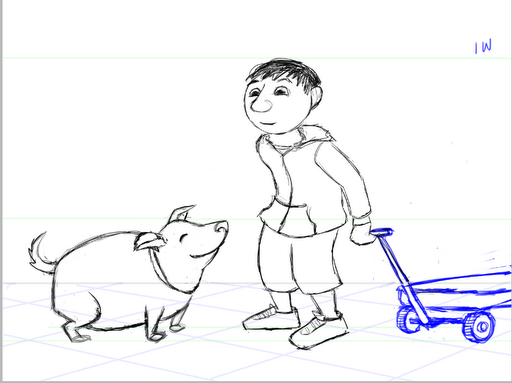
I designed them for a three-week assignment for a “heavy lifting” exercise. The focus was first on the thinking that takes place before lifting something heavy; then on portraying weight, then losing a grip on the heavy object. I could have just used a static object instead of a dog, but I really like the idea of a fat little dog (scroll down on that link for my favorite Pompeii dog).
This assignment was similar to last semester’s “stagger” exercise, where I animated a fishwife trying to lift a huge, heavy fish.
Since I was focusing on the broad action of the rough animation, I didn’t have a chance to add facial features…hopefully I’ll get to that someday!
3-point perspective (and 2-point vertical)
Posted on March 12, 2012
Here’s another Drawing from the Imagination assignment – three-point perspective (+ two-point vertical).
You can tell when something’s in three-point perspective when there are barely any truly vertical lines – all of them slant off to some point in the distance (in this case, out side of the picture to the bottom, right & left). The two-point vertical comes into play if you want to create an object that has a plane parallel to the picture plane (see the box on the shelf – the edges facing us are perfectly horizontal).
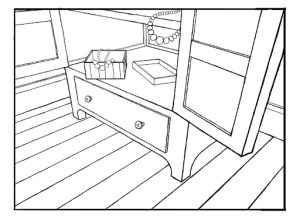
I didn’t use as much photo reference for this, and the thumbnails got buried in my photoshop layers so there’s nothing appealing to post from them, but it was a fun assignment once I figured out the point of view and composition that I ultimately wanted.
sneaky goose walk
Posted on March 10, 2012
two-point perspective interior
Posted on March 6, 2012


mabel moves
Posted on March 1, 2012
This video is a combo of two assignments for my Traditional Animation 2 class – getting up out of a chair and “easing in” to a walk. In order to smoothly start or stop any action in animation, you have to carefully space the drawings so that the motion doesn’t start awkwardly or end too abruptly.
Keep in mind this is just a simple pencil test- no details, but hopefully the acting brings the character to life. Enjoy!
I'm an illustrator and 2D animator who likes lots of stuff, including science, bright colors and figuring out how things work.

 Sarah Lynne Reul